
How Poor Vision Affects Learning: What Teachers Know and Parents Don't
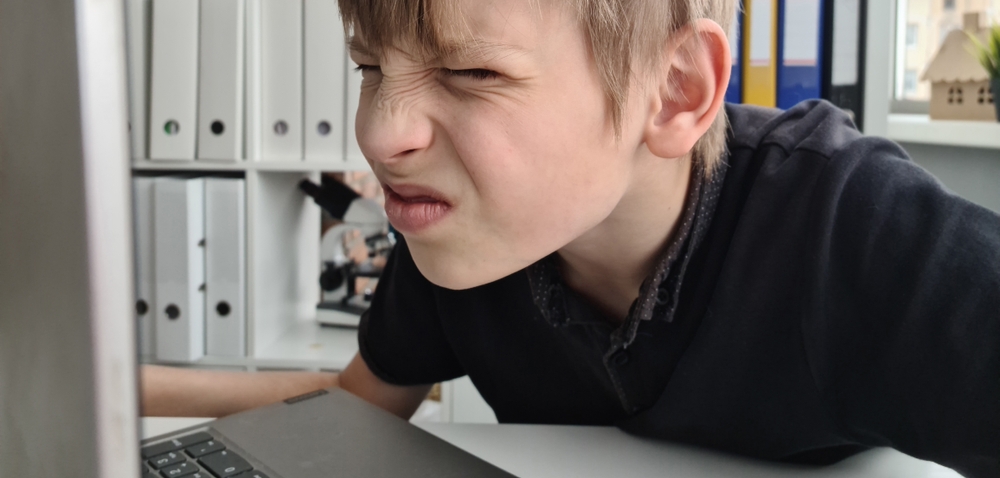
Every August, I see the same thing walk into my exam chair: a kid who's been labeled inattentive, a slow reader, or “just not that into school” — when the real problem was sitting eighteen inches from their face the whole time.
Teachers tend to catch it before parents do. Not because teachers are more observant about eyesight specifically, but because they're watching thirty kids do the same task at the same time, every day. They notice the one who tilts their head to see the board. The one who loses their place constantly when reading aloud. The one whose handwriting drifts downhill across the page. Parents, at home, usually just see a kid who seems tired, distracted, or “difficult” about homework — and it's an easy jump to attention or behavior before anyone thinks to check vision.
The School Screening Gap
Most schools run a basic vision screening — and most kids pass it. That's because those screenings are built to catch one thing: whether a child can read letters on a chart from twenty feet away. That's useful, but it's a narrow slice of what “seeing well enough to learn” actually requires.
Reading, writing, and working from a whiteboard all demand something screenings don't test:
Near vision and focusing stamina — the ability to keep close-up print sharp for an extended stretch, not just for a few seconds on a chart
Eye teaming and tracking — both eyes working together smoothly to follow a line of text without losing their place or skipping words
Eye-hand coordination — translating what's seen into copied notes or handwriting accurately
A child can have perfect distance vision and still struggle significantly with any of these — and still pass the school screening every single year.
What This Looks Like in a Classroom (and at Home)
The signs are often mistaken for something else entirely:
Avoiding reading or homework, described as “laziness” or “not liking school”
Frequent headaches or eye rubbing by the end of the school day
Skipping lines or losing their place while reading
Sitting unusually close to the TV or holding books very close
Covering one eye, or tilting the head to see something clearly
Any one of these, on its own, could be nothing. But together, or repeated day after day, they're worth a real look — not a school screening, a comprehensive exam.
What a Comprehensive Exam Actually Checks
At Michigan Eye Consultants, a comprehensive exam for a school-age child goes well beyond the letter chart. We evaluate near-focusing ability, how well the eyes team together for reading, and overall eye health — the pieces of the puzzle a hallway screening was never designed to catch.
For some kids, the answer is glasses. For others, it's identifying a focusing or teaming issue that responds to a different kind of correction or in-office therapy. Either way, the goal is the same: rule vision out — or catch it early enough that it stops being the invisible reason a capable kid is struggling.
When the Answer Is More Than Glasses
For some kids, the exam turns up something beyond a standard prescription — a nearsightedness that's progressing year over year. If that's the case, it's worth knowing Michigan Eye Consultants also offers myopia management for children: a specialized approach designed to slow that progression, not just correct for it each time it worsens. It's not the right fit for every child, but it's exactly the kind of thing a comprehensive exam is built to catch early — while there's still the most room to act on it.
Before the School Year Locks Back In
August is exactly the right window for this. Once the school year is underway, it gets a lot harder to tell whether a rough start is a vision problem, a fresh-teacher adjustment, or something else — the noise piles up fast. Right now, before the first day, a comprehensive exam gives you a clean answer either way.
Don't Wait Until the Waitlist Decides For You
August appointments are booking up fast this time of year, and once school starts, exam slots get a lot harder to find. If your child hasn't been seen yet, this week is the week to call.
586-302-3222
Serving Madison Heights, Troy, Royal Oak, Birmingham, and Bloomfield Hills families.
Quick Links
Helpful Articles

All Eye Care Services
Find personalized eye care excellence with our comprehensive services. From eye exams to advanced diagnostics, trust us for all your vision needs.

Keep In Touch
For non-urgent questions or to learn more about our services, contact us today!

© 2026 Michigan Eye Consultants. All rights Reserved - Accessibility Statement - Privacy Policy - Sitemap
Managed and Designed by 
Michigan Eye Consultants
Patient Advisor
Online
Hello!I'm the MEC Patient Advisor. I can answer questions about our Advanced Dry Eye Program,Neurolens,specialty lenses,pricing,and help get you scheduled with Dr. Wong. What brings you in today?