
Why Your Eyes Could Be Causing Your Headaches, Neck Pain & Dizziness And What to Do About It
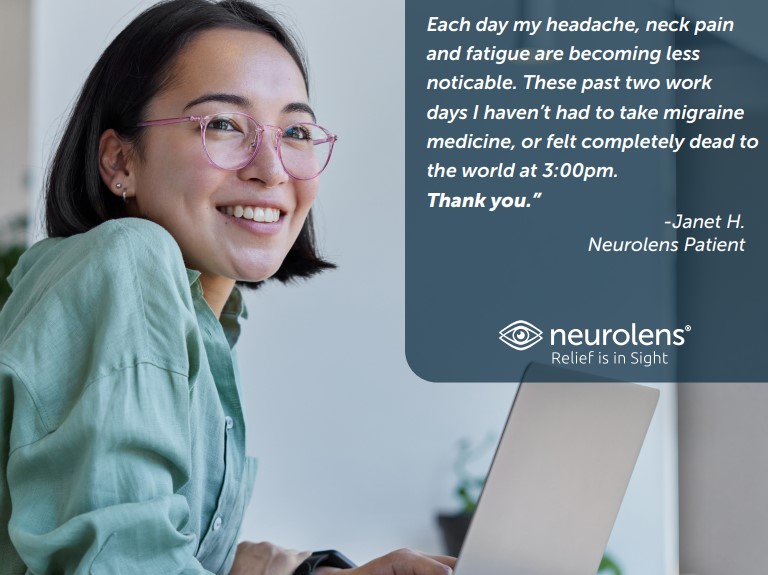
Why Your Eyes Could Be Causing Your Headaches, Neck Pain & Dizziness And What to Do About It
Understanding Binocular Vision Dysfunction (BVD) and How Neurolens Technology Can Help
Do you find yourself reaching for ibuprofen every afternoon? Do you feel dizzy in busy stores or after staring at a screen? Have chiropractors, neurologists, and specialists told you everything looks normal — yet you still don’t feel right?
You are not alone. And you may not be imagining things.
As an optometrist, one of the most rewarding parts of my work is helping patients connect the dots between symptoms that seem completely unrelated and tracing them back to a single, correctable source: eye misalignment. This condition, clinically known as Binocular Vision Dysfunction (BVD), affects more people than you might think — and it often goes undiagnosed for years.
In this post, I want to walk you through what BVD really is, how it quietly wreaks havoc on your entire body, and how our practice uses cutting-edge Neurolens technology to identify and treat it.
What Is Eye Misalignment (Binocular Vision Dysfunction)?
Your eyes are meant to work as a team. Every time you look at something — near or far, on a screen or across the room — your brain sends precise signals to the six tiny muscles surrounding each eye, directing them to point at exactly the same spot at exactly the same time. This seamless coordination is what gives you clear, comfortable, three-dimensional vision.
But for many people, the eyes don’t naturally align perfectly. This is called Binocular Vision Dysfunction (BVD) — a condition in which the visual axes of the two eyes are slightly misaligned, forcing the brain and visual system to constantly work overtime just to maintain single, stable vision.
Here’s the critical thing most people don’t know: the misalignment in BVD can be incredibly subtle — sometimes just a fraction of a degree — but the impact on how you feel every single day can be profound.
Common Symptoms of BVD — You Might Recognize Some of These:
Chronic headaches or migraines
Neck pain or stiffness
Dizziness or a feeling of being “off balance”
Motion sickness (in cars, on escalators, in busy environments)
Eye strain, tired eyes, or aching eyes
Light sensitivity (indoors and outdoors)
Difficulty reading or following lines of text
Anxiety in open spaces or crowded areas
Fatigue, brain fog, or difficulty concentrating
The Brain-Body Connection: How Eye Misalignment Causes Physical Pain
This is the part that surprises most of my patients. They come in expecting me to talk about blurry vision. Instead, I explain why their neck has been hurting for three years.
Your Brain Will Compensate — At a Cost
When the eyes are misaligned, the brain does something remarkable: it refuses to give up on clear, single vision. Instead, it recruits help from every available system to compensate. The trigeminal nerve — the largest sensory nerve in the head — becomes chronically overstimulated as it works to “force” the eyes into alignment.
This constant neural overdrive triggers headaches, facial tension, and sensitivity to light in many BVD sufferers.
The Neck Muscles Step In
Here’s where it gets even more interesting. Your brain doesn’t stop at the trigeminal nerve. It also consciously and unconsciously recruits the muscles of your neck and upper back to help position your head in a way that makes it easier for the misaligned eyes to work together.
Think of it this way: if one eye tends to drift slightly upward or inward, you might naturally tilt your head to compensate — without even realizing you’re doing it. Over hours and days and years, those muscles — the sternocleidomastoid, the upper trapezius, the cervical paraspinals — never fully relax. They’re always on duty.
The result? Chronic neck stiffness, upper back tension, and pain that no amount of massage therapy, chiropractic work, or stretching will permanently resolve — because the root cause (the visual system) has never been addressed.
Why Dizziness and Motion Sickness Occur
Your sense of balance and spatial orientation depends on three systems working in harmony: your inner ear (vestibular system), your body’s sense of position (proprioception), and your visual system. When the visual system sends conflicting signals — as it does in BVD — the brain struggles to reconcile the input. The result is dizziness, a feeling of being “off,” or severe motion sickness even in ordinary situations like grocery shopping or riding as a passenger.
Light Sensitivity Explained
Many BVD patients are acutely sensitive to bright lights, fluorescent lighting, or sunlight. When the eyes are misaligned, the brain is working so hard to fuse the two slightly different images from each eye that additional visual stimulation — like intense or flickering light — can overwhelm the system, triggering headaches, eye pain, and discomfort.
How We Diagnose BVD: The Neurolens Headset Technology
One of the most frequent questions I hear is: “Why hasn’t anyone figured this out before?” The honest answer is that traditional eye exams are not designed to detect the kind of subtle misalignment associated with BVD. Standard vision tests measure acuity — how clearly you can see — not how well your eyes work together under the sustained demands of real-world visual tasks.
That’s why we use the Neurolens Measurement Device: an advanced diagnostic headset specifically developed to detect and quantify eye misalignment in ways a conventional exam simply cannot.
What the Headset Does
The Neurolens Measurement Device is an FDA-cleared, eye-tracking diagnostic tool that measures your eye alignment under multiple, controlled conditions — including at distance and at near, and under varying visual demands that mimic real-world activities.
Here is what the process looks like for our patients:
You are comfortably seated and the headset is gently positioned. No drops, no discomfort.
The device presents a series of visual targets and tracks exactly where each eye is pointing, moment to moment, with high precision.
Within a few minutes, the system generates a detailed map of your eye alignment, including whether there is a vertical, horizontal, or torsional misalignment — and how large that misalignment is.
The results tell us whether you are a candidate for Neurolens treatment, and if so, how much correction your lenses need to incorporate.
This technology allows us to quantify something that was previously very difficult to measure in a clinical setting. Many patients who have spent years bouncing between specialists finally have an answer in a single appointment.
What Is Neurolens Technology?
Neurolens is an innovative optical lens technology designed specifically to address the visual misalignment at the root of BVD symptoms. Neurolens lenses incorporate a contoured prism — a precisely calculated prismatic correction that is built directly into your eyeglass lenses.
What Makes Contoured Prism Different?
Traditional prism lenses, when prescribed for misalignment, deliver a uniform correction across the entire lens. But your eyes’ alignment needs are not uniform — they differ depending on whether you are looking at something far away versus close up, such as a phone or computer screen.
Neurolens uses a contoured (graduated) prism that varies across the lens. At distance, it provides the precise amount of correction needed for your eyes to align comfortably far away. As you look into the reading zone of the lens, the prism gradually changes to address the different alignment demand for near vision.
The result is that your visual system is supported correctly at every distance — reducing the constant neurological effort that has been driving your symptoms.
What Patients Experience
Results vary by individual, but many patients report significant improvement in their symptoms within the first few days to weeks of wearing Neurolens glasses. In clinical studies, over 93% of patients reported symptom relief.
Common improvements our patients describe:
Noticeably fewer or less severe headaches
Reduced neck tension and upper back discomfort
Less eye strain during screen time and reading
Improved tolerance for busy or visually complex environments
Decreased dizziness and better balance in everyday situations
Reduced sensitivity to bright lights and glare
Q&A: Your Questions About Eye Misalignment and Neurolens, Answered
Q: I’ve had my eyes checked before and was told my vision is fine. How could I have BVD?
A: This is the most common thing I hear. A standard eye exam checks how clearly each eye sees — it measures visual acuity. It does not specifically measure how well your eyes work together as a coordinated team, nor does it detect the type of subtle misalignment associated with BVD. The Neurolens diagnostic headset uses eye-tracking technology to identify misalignment that traditional exams are not designed to catch. Many of our BVD patients have perfect 20/20 acuity.
Q: Could my headaches really be caused by my eyes? My doctor said it’s tension headaches.
A: Tension headaches are a description of a symptom, not a root cause. Eye misalignment is a known and well-documented trigger of tension-type and cervicogenic headaches because of the sustained muscle effort and trigeminal nerve activation involved. If you’ve been treating tension headaches without finding lasting relief, it is absolutely worth investigating whether your visual system is contributing.
Q: Is the Neurolens headset evaluation uncomfortable or time-consuming?
A: Not at all. The evaluation takes approximately 2–3 minutes. You simply look at targets presented by the headset — there are no air puffs, no dilating drops, and nothing invasive. Most patients find it easy and even interesting to see their own eye alignment data displayed on the screen.
Q: How long does it take to feel relief once I start wearing Neurolens glasses?
A: Most patients notice meaningful improvement within the first few days to weeks of wearing their Neurolens glasses. Some people experience an initial adjustment period as their visual system adapts to the correction — this is normal and expected. We monitor your progress and can make adjustments to ensure you are getting the maximum benefit.
Q: Will I need to wear Neurolens glasses all the time?
A: Most patients wear their Neurolens glasses full-time, especially since symptoms are often triggered by sustained near work like reading and screen use. We’ll discuss your specific prescription and lifestyle during your consultation and tailor our recommendations to your needs.
Q: Are Neurolens glasses covered by insurance?
A: Neurolens is a specialized therapeutic technology, not a standard vision correction — so it falls outside the scope of vision coverage. Many patients apply FSA or HSA funds toward their lenses, which makes the investment more manageable. We also offer flexible financing through CareCredit and Afterpay. Our team will walk you through your options at your consultation. Many patients find that the relief from chronic headaches, neck pain, and eye strain more than justifies the cost — especially when compared to ongoing expenses for pain medication, chiropractic visits, or massage therapy.
Q: What if I don’t wear glasses — can I still have BVD?
A: Yes. BVD is about how the eyes work together, not about whether you need a refractive correction. You do not need to currently wear glasses or contacts to have eye misalignment. Neurolens can be prescribed in plano (non-magnifying) lenses just to deliver the prism correction your visual system needs.
Ready to Find the Root Cause of Your Symptoms?
Schedule Your Eye Health Consultation Today
You deserve answers — not just symptom relief. Dr. Wong and our team
use advanced Neurolens technology to find out if eye misalignment is at the root
of your headaches, neck pain, dizziness, or fatigue.
📞 Call us today: (586) 302-3222 or (586) 302-3222
📍 29273 Dequindre Rd, Madison Heights, MI 48071
Or book online at michiganeyeconsultants.com. Our team is ready for you.
Our Eye Health Consultation is specifically designed to evaluate your visual system comprehensively — including Neurolens screening using our diagnostic headset. Dr. Wong will review your symptoms, your history, and your results and discuss whether Neurolens is the right next step for you.
This blog post is intended for informational purposes and does not constitute medical advice. Please schedule a consultation with Dr. Wong to discuss your individual symptoms and health history.
Quick Links
Helpful Articles
article_category: products
article_category: psychiatry
article_category: faqs
article_category: cats
article_category: general
article_category: services
article_category: technology
article_category: dogs
article_category: restorative
article_category: vision therapy
article_category: contact lenses
article_category: health
article_category: conditions
article_category: eye surgery co-management
article_category: exotic
article_category: cosmetic
article_category: surgical procedures
article_category: aesthetics
article_category: preventative
article_category: ocular disease management
article_category: eyeglasses
article_category: eye health
article_category: large animal
[]
article_category: psychiatry
article_category: faqs
article_category: cats
article_category: general
article_category: services
article_category: technology
article_category: dogs
article_category: restorative
article_category: vision therapy
article_category: contact lenses
article_category: health
article_category: conditions
article_category: eye surgery co-management
article_category: exotic
article_category: cosmetic
article_category: surgical procedures
article_category: aesthetics
article_category: preventative
article_category: ocular disease management
article_category: eyeglasses
article_category: eye health
article_category: large animal
[]
Flowbite is an open-source library of interactive components built on top of Tailwind CSS including buttons, dropdowns, modals, navbars, and more.
Check out this guide to learn how to get started and start developing websites even faster with components on top of Tailwind CSS.

All Eye Care Services
Find personalized eye care excellence with our comprehensive services. From eye exams to advanced diagnostics, trust us for all your vision needs.

Keep In Touch
For non-urgent questions or to learn more about our services, contact us today!

© 2026 Michigan Eye Consultants. All rights Reserved - Accessibility Statement - Privacy Policy - Sitemap
Managed and Designed by 
Michigan Eye Consultants
Patient Advisor
Online
Hello!I'm the MEC Patient Advisor. I can answer questions about our Advanced Dry Eye Program,Neurolens,specialty lenses,pricing,and help get you scheduled with Dr. Wong. What brings you in today?